
Planning a corporate event for 500+ employees in Bangalore means locking a venue rated well above 500 capacity, building a budget in the ₹8 lakh to ₹60 lakh range depending on format, and running dedicated systems for transport, registration and contingency that a 200-person event never needs. Start venue and vendor booking 10 to 12 weeks out; anything closer than 6 weeks limits your venue choices in the city’s peak season.
A 200-person team outing and a 500-person annual day are not the same project scaled up. Once headcount crosses 500, three things break first: the venue’s real usable capacity, the food service window, and the ability to track who has actually arrived. This guide walks through the ten decisions that determine whether a large corporate event in Bangalore runs on time or falls apart at registration.
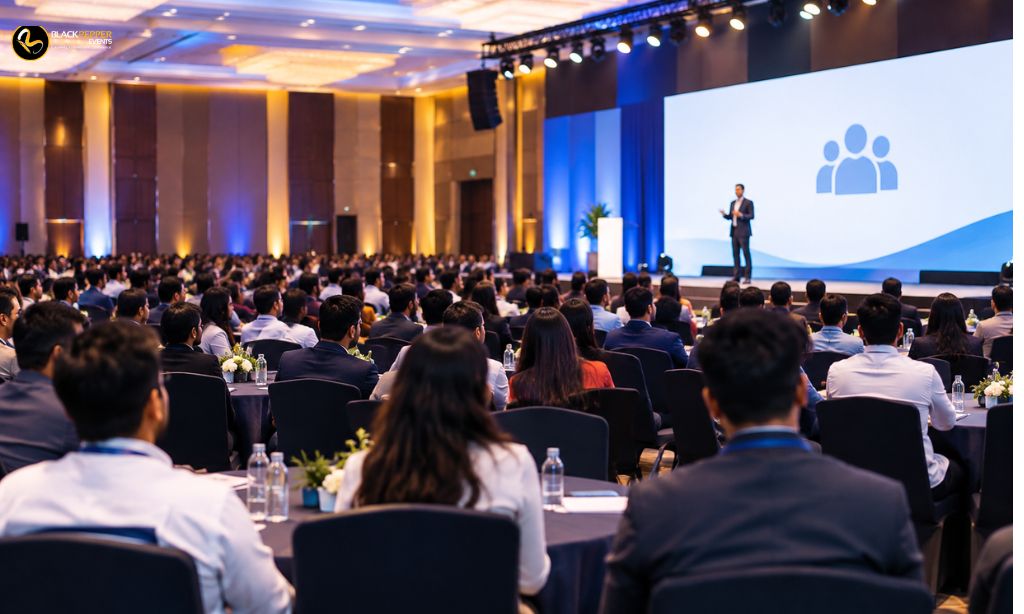
Large corporate event planning in Bangalore runs into constraints a 100 or 200-person event never faces. Most event venues list a theatre-style capacity that assumes rows of chairs and nothing else. Add a stage, AV rigging, food counters and walkways, and that number drops fast. A hall rated for 700 in theatre-style seating routinely holds 450 to 500 comfortably once round tables, a stage and buffet stations are placed.
These are the specific problems this guide solves. For the foundational planning process, corporate event planning timelines and goal-setting that apply to events of any size, Black Pepper Events has covered that ground separately; this piece stays focused on what changes once you’re past 500 attendees.
An annual day, a leadership town hall, a product launch and a channel partner meet all draw a crowd of 500+, but they need different formats. A recognition-heavy annual day needs a stage and an awards flow; a town hall needs strong AV and Q&A logistics; a partner meet needs a business-card-and-networking layout. Fix the purpose before touching a venue brochure, because it decides seating style, run-of-show length and whether families are invited.
Get a firm headcount, not a round number. “About 500” and “520 confirmed, 40 possible walk-ins” lead to different catering and seating decisions. If the event includes employee families (common for annual days), model two numbers separately: employee count and total footfall including plus-ones, since catering and parking are planned against the larger figure.
Bangalore’s large-format venues fall into a few practical categories for a 500+ crowd. The table below compares them on the factors that actually decide fit: real usable capacity, parking, and how well suited each is to a corporate audience versus a purely social one.
Venue Type | Realistic Capacity (with stage + tables) | Parking | Best Suited For |
5-star hotel ballroom | 300–600 | Valet, limited on-site | Awards nights, leadership summits, formal dinners |
Dedicated convention centre | 500–2,000+ | Large dedicated lots | Conferences, product launches, multi-track town halls |
Banquet hall / event lawn | 400–800 | Moderate, often off-site overflow needed | Annual days, family days, outdoor-friendly formats |
Resort / offsite property | 300–700 (residential) | On-site, but limited for day visitors | Multi-day offsites combined with an annual day |
Whichever category you shortlist, ask for the venue’s capacity with your actual floor plan (stage, buffet counters, photo booth, registration desk) marked in, not the bare theatre-style number on their rate card. A hall rated for 700 that has never hosted a stage-plus-buffet layout at that size is a bigger risk than a hall rated for 550 that runs this format every month.
Black Pepper Events’ own published Bangalore cost data puts full-scale conferences and summits in the 50–500 pax band between roughly ₹8 lakh and ₹60 lakh, with flagship awards-night formats running ₹15 lakh to ₹70 lakh+ depending on venue category, production scale and F&B choices. A 500+ employee event, sitting at or above the top of that pax band, should be budgeted toward the upper half of the range rather than the entry point.
A practical way to break down a 500+ event budget:
Budget Head | Typical Share of Total | Notes |
Venue + catering | 45–65% | The single largest line; scales directly with headcount and menu style |
Stage, AV and production | 10–20% | Rises sharply if live streaming or multi-screen setups are added |
Transport | 5–10% | Depends on how many pickup points are needed across the city |
Registration, security and staffing | 5–10% | Includes check-in hardware, ushers and crowd management staff |
Contingency reserve | 10–12% | Held back, not spent upfront, for last-minute overruns |
Add 18% GST on event management service fees when comparing quotes from different vendors, since some quotes are shown inclusive and others exclusive. Keep the 10–12% contingency reserve fully unspent until the week of the event; it is the line that most often gets absorbed into the main budget too early, leaving no buffer for a last-minute vendor or weather change.
A single buffet line cannot serve 500 people inside a reasonable window. Plan for at least four to six parallel counters split by cuisine or course, and stagger the meal service across two seating batches if the venue’s dining area cannot seat everyone at once. Confirm the caterer’s own experience at this scale specifically; a caterer whose largest past event was 200 covers will underestimate counter staffing for 500.
At 500+ attendees, sightlines and audio coverage matter more than screen size. A single central screen works for a narrow hall; a wide or L-shaped hall needs side screens or IMAG (image magnification) so the back rows can actually see the stage. Test microphone coverage across the full seating width during rehearsal, not just at the podium, since handheld mics for audience Q&A are the most common weak point at this scale
A run-of-show for 500+ people needs tighter time discipline than a smaller event, because delays compound: a 10-minute overrun on an awards segment pushes dinner service, which pushes the closing act. Build a printed or shared run-of-show with hard timestamps for every segment, and assign one person (not the emcee) to actively manage the clock backstage.
When employees are arriving from multiple office locations or a wide spread of home addresses, transport needs a staging plan, not just a headcount of cabs booked. Group pickups by area into a small number of bus or shuttle routes with fixed departure windows, and share the schedule with employees at least three days in advance so arrival times stay predictable at the venue gate.
A printed guest list and a pen is the single most common bottleneck at large corporate events in Bangalore. For 500+ attendees, use a QR-code or barcode-based check-in system linked to your registration form, with at least four to six check-in counters running in parallel. Each counter should handle no more than 100–125 guests to keep the queue under 10 minutes during the peak arrival window. Assign one corporate event coordinator to own this flow end to end, from pre-registration data through to the last guest checked in, so no single issue at the gate becomes everyone’s problem.
Pre-register everyone through a simple online form 5–7 days before the event, collecting name, department, dietary preference and transport requirement in one step. This single form removes the need for on-the-spot data collection, which is what slows registration lines down the most.
At 500+ headcount, a single point of failure has a much bigger blast radius. Build specific contingency triggers, not a vague “we’ll handle it” plan:
For an event of this scale in Bangalore, a 10–12 week runway is the realistic minimum; anything under 6 weeks sharply narrows venue and vendor availability, especially in the October–March event season.
Timeline | Key Actions |
10–12 weeks out | Confirm purpose, headcount, budget band and shortlist 3–4 venues with real capacity checks |
8–9 weeks out | Lock venue, caterer and AV vendor; open the pre-registration form |
5–6 weeks out | Confirm run-of-show, transport routes and pickup hubs; finalise dietary and headcount data |
2–3 weeks out | Vendor rehearsal walkthrough; confirm check-in counter count and staffing |
Event week | Final headcount lock, contingency checks, transport schedule shared with all attendees |
Below 200 attendees, an in-house team can often manage the full process. Past 500, the coordination load, vendor management and the systems described above (staggered transport, parallel registration, contingency planning) typically need a team that runs events at this scale regularly. Bangalore has no shortage of corporate event management companies, but experience running exactly this headcount, not just corporate events in general, is what separates a smooth 500+ event from a stressful one. Black Pepper Events has covered the fuller in-house versus professional event management comparison separately; the short version for a 500+ event specifically is below.
Factor | In-House Team | Professional Event Partner |
Vendor network at scale | Limited to known contacts | Established relationships with venues and vendors that regularly handle 500+ |
Time investment | Weeks of internal team time diverted from core work | Internal team stays focused; execution is outsourced |
Risk management | Contingency planning often informal | Structured contingency and on-ground crisis handling |
Cost | Lower agency fee, but hidden internal time cost | Agency fee, offset by fewer overruns and re-bookings |
Among the top corporate event planning companies operating in Bangalore, relatively few run events at the 500+ headcount regularly enough to have the venue, catering and logistics playbook this guide describes already tested. Black Pepper Events has been managing corporate events in Bangalore since 2008, working with organisations including TCS, Mahindra, HCL, Flipkart, EY and Genpact on formats ranging from annual days and awards nights to MICE events and product launches. For a 500+ employee event specifically, that experience translates into venue shortlists that account for real usable capacity, catering plans built around parallel service counters, and the transport and registration systems this guide covers.
Related services: MICE event management, Annual Day & Award Nights, Virtual & Hybrid Events.
Corporate event planning for 500 or more employees comes down to the systems around the event, not just the programme on stage: a venue checked against your real floor plan, a budget with the contingency fully held back, catering built for parallel service, and transport and registration designed for the arrival numbers you’ll actually see. Get those four right and the event itself runs the way it looks on paper.
If you’re weighing venues, vendors or a realistic budget band for a specific headcount and date in Bangalore, Black Pepper Events can walk through the options for your event.
Planning a corporate event for 500 or more employees in Bangalore? Black Pepper Events has managed large-scale corporate events across Bangalore since 2008. Talk to our team to discuss venue, budget and logistics for your event size and date. |
How much does it cost to plan a corporate event for 500+ employees in Bangalore?
Based on Black Pepper Events’ own published Bangalore cost data, conferences and summits in the 50–500 pax range typically run ₹8 lakh to ₹60 lakh, and flagship awards-night formats can run ₹15 lakh to ₹70 lakh or more, depending on venue category, production scale and catering choices.
What venue capacity should I look for a 500-employee event?
Look for a venue rated well above 500 in theatre-style seating, since adding a stage, buffet counters and walkways typically reduces usable capacity by 25–35%. Always ask the venue to confirm capacity against your actual floor plan.
How many weeks in advance should a 500+ employee event be planned?
10 to 12 weeks is a realistic minimum for a 500+ employee event in Bangalore. Anything under 6 weeks significantly narrows venue and vendor availability, particularly during the October–March peak season.
Should a company plan a 500+ employee event in-house or hire a professional event management company?
In-house teams can often manage events under 200 attendees. Past 500, the vendor coordination, transport staging and contingency planning involved typically benefit from a team that manages events at this scale regularly.
What is the most common mistake companies make when planning large corporate events?
Booking a venue by its bare theatre-style capacity number instead of its capacity with the actual event floor plan (stage, catering counters, registration desk) accounted for. This single error causes more last-minute space problems than any other planning mistake.
About the Author
Pradeep Chagal is the Founder & CEO of Black Pepper Events, a Bangalore-based corporate event management company operating since 2008. He has led the planning and execution of large-scale corporate events for organisations including TCS, Mahindra, HCL, Flipkart, EY and Genpact.
Reviewed By
L K Monu Borkala is a digital marketing strategist with 20+ years of SEO experience and over 650 client campaigns across India and UAE. As a founding member of OneCity Technologies, Bangalore, he oversees content strategy and editorial compliance across business services and events verticals.