
Annual day stopped being an HR checkbox a while ago. It is now a culture and retention signal, employees quietly compare what their company does to what a friend’s company did last year, and a flat, repeat-the-format event says something about the organisation whether anyone intends it to or not. Gallup’s own workplace research has tracked recognition as one of the stronger levers on engagement for years, and an annual day is one of the few moments a company gets to do it publicly, at scale, in one evening. Since 2008, our production team has planned everything from intimate boardroom dinners to 3,000-person annual day celebrations across Bangalore, here’s everything we’ve learned about what actually makes one land. This guide covers twelve corporate annual day themes for 2026, how we bring a theme to life, the program structure every great annual day needs, award category ideas, a planning timeline, what actually drives the budget, and the mistakes we see most often, all grounded in events we have actually run, not a generic checklist.
A great annual day does two things most companies only manage one of: it makes people feel specifically recognised, not generically celebrated, and it gives the evening enough structure that the room never goes flat. SHRM’s guidance on employee recognition consistently points to specific, timely recognition over generic praise, which is exactly where an awards segment either earns its place on the programme or falls flat. The purpose is recognition and cultural reinforcement, and the honest success metric is employee participation and post-event sentiment, not how the stage looked in photos. The format that actually works is entertainment-heavy: awards, performances, and a leadership address, sequenced so energy builds rather than dips partway through. A theme gives the night a visual identity, but the theme alone does not make the evening land. What makes it land is whether people who worked hard this year got a specific, named moment, and whether the programme respects everyone’s attention span instead of running well past when the room has checked out.
A theme should say something specific about the company this year, not just look good in photos. Good annual day themes for corporates and other corporate event themes share one trait: they suit a specific kind of company and a specific message, not every audience at once. These twelve corporate annual day themes for 2026 each suit a different kind of company and a different kind of message:

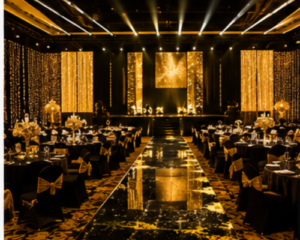
A black-tie, high-shine visual language: gold sequins, dramatic uplighting, a step-and-repeat photo wall, formal seating. Suits established companies that want the night to feel like a genuine occasion, not a themed party, and pairs especially well with a formal awards sequence, since the visual weight matches the tone of real recognition.
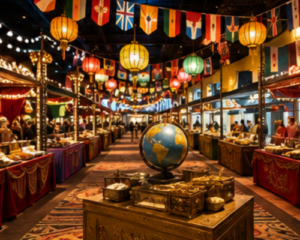
Each catering or activity station represents a different country or region, food, music, and small cultural touches, without turning into caricature. Suits companies with a truly multicultural or multi-location workforce, since it gives every region’s employees a moment of visibility rather than treating one culture as the default.
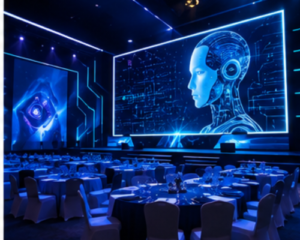
A near-future visual identity: clean tech aesthetics, screens used as a design element rather than an afterthought, and content that actually engages with how AI is changing the company’s own work, not a generic tech-party backdrop. Suits technology and IT-services companies specifically, since the theme only lands if the content on stage backs it up.
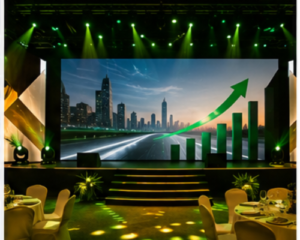
Built around the company’s own trajectory: where it started, what it has built, where it is heading. Works best when leadership is willing to share real numbers and real milestones on stage, since a vague “exciting future” narrative falls flat fast. Suits companies at a genuine inflection point, a funding round, a market expansion, a founding anniversary.
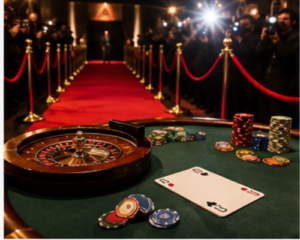
Red carpet entry, professional photography at the door, a casino-adjacent visual language, green felt tables, playing-card motifs, without needing actual gambling. Suits companies that want the awards portion to feel like the main event rather than a segment squeezed in before dinner.
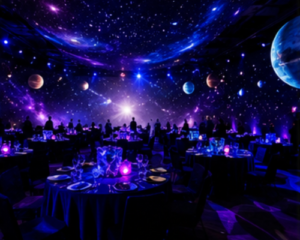
Deep blues and purples, starfield projection, and a space-exploration narrative thread that can double as a metaphor for company growth or ambition. Suits companies that want a theme with strong photo appeal and enough flexibility to hold both a formal and a fun tone across the evening.
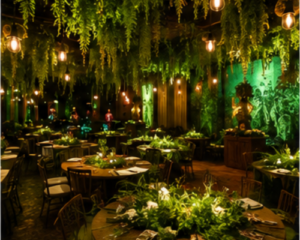
Decor built from reusable or actually sustainable materials, plant-forward styling, and a menu that reflects the theme rather than decor doing all the talking. Suits companies where sustainability is an actual part of the brand story, since the theme reads as hollow if it is decor-only with no substance behind it.
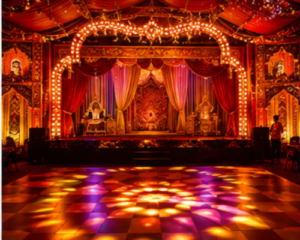
Classic Hindi cinema visual language, era-specific music, and a dance floor people actually use rather than watch. Suits companies wanting a high-energy, unapologetically fun night, and tends to have the broadest cross-generational appeal of any theme on this list.
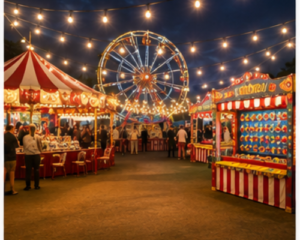
Game stalls, a lighter catering format, roaming entertainment, and a real, informal atmosphere that works well when the goal is team bonding as much as recognition. Suits companies that want the evening to feel less like a gala and more like a celebration everyone can move around in.
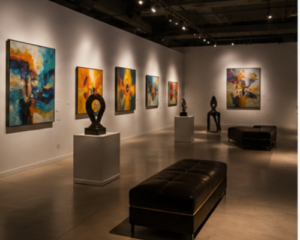
The venue styled as a gallery or immersive installation space, with employee or team achievements presented as “exhibits” and interactive art stations. Suits companies with a strong creative or design identity, and works particularly well for smaller, more intimate annual days where the format can stay personal.
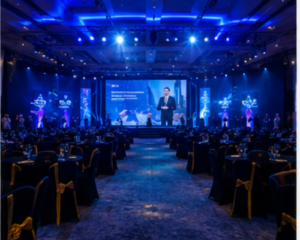
A hybrid format: a genuine content or town-hall segment in the first half, transitioning into a celebration format for the second. Suits companies that want to combine a real strategic update with the recognition moment, rather than running two separate events across two different evenings.
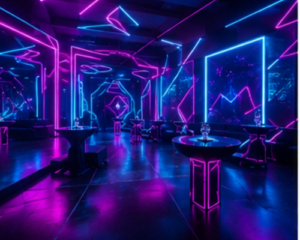
UV and neon lighting, digital-art visual elements, and a distinctly current tech aesthetic without needing an actual VR component. Suits younger workforces and companies wanting the night to feel unmistakably 2026, not a theme that would have looked the same five years ago.
Every theme starts with your brief: budget, headcount, and the culture point you actually want the night to make. This is the same process we use across corporate event planning in Bangalore more broadly, not a separate track for annual days specifically.
Planning Your Annual Day?
Beyond theme and decor, the strongest annual day party ideas still depend on the same programme fundamentals:
The timeline below covers the annual-day-specific milestones; our full step-by-step guide to planning a corporate event in Bangalore covers the broader planning process in more depth.
Timeline | What to Lock In |
8–12 weeks before | Theme direction, guest count, venue, budget approval, and major vendor bookings |
4–6 weeks before | Award categories and nominees, entertainment booked, stage and branding design finalised |
2 weeks before | Full show flow confirmed, technical rehearsal scheduled, final guest count locked |
Week of the event | Technical rehearsal completed, load-in and load-out timing confirmed with the venue, final run-through |
Large conferences and annual days: Sheraton Grand, The Lalit Ashok, and JW Marriott offer strong ballroom capacities with breakout options for a programme that mixes formal segments and celebration. For larger-scale or trade-show-adjacent annual days, BIEC and KTPO Whitefield offer the floor space smaller ballrooms cannot match. Manpho Convention Centre and Sheraton Brigade Gateway have both hosted annual days we’ve run directly. Our full guide to corporate event venues in Bangalore breaks down more options by event type. The right venue depends on guest count, whether you need breakout space for awards rehearsal, and whether the format is seated-formal or move-around-informal.
As an annual day event organizer in Bangalore, our track record is built on outcomes that outlast the evening itself, not just a well-produced night.
For one Bengaluru-based company’s annual awards night, the goal was to celebrate employees without repeating last year’s format. We built a fresh theme, structured storytelling around specific achievements, and choreographed a high-energy show end to end. The HR team later reused the event’s visuals and video content across hiring campaigns and internal communication through the rest of the year, the kind of outcome we aim for on every annual day: an event that keeps earning its budget back after the night itself is over. In-house AV, stage production, and fabrication mean core production is never subcontracted, and one project lead stays accountable from the first brief through the post-event wrap report, so nothing falls into the gap between sales and delivery teams. More on how we approach corporate events end to end covers the process in more depth.
Book a free consultation with Black Pepper Events. Call +91 73380 80555, or
share your brief through the contact page, and we’ll come back with theme directions and a clear proposal.
How far in advance should we start planning a corporate annual day?
Most companies start planning 8 to 12 weeks ahead, and 4 to 6 months ahead for a fully custom theme build or a venue like BIEC that needs a longer lead time. Starting early gives more room to lock the right venue and theme rather than settling for whatever is available.
What is a realistic budget range for a corporate annual day in Bangalore?
Budget depends most on guest count, venue category, and production complexity, so there is no single number that fits every company. Sharing your headcount and format gets you a real estimate rather than a generic range that may not reflect what you actually need.
How do we choose the right theme for our company?
Start with your guest count, venue, and the cultural point you want the night to make, some themes suit a truly multicultural workforce, others suit a company at a specific growth milestone. The right starting question is not “what looks good” but “what does this theme actually say about us this year.”
How many award categories should an annual day have?
Most annual days work well with 6 to 10 categories, enough to recognise a genuine range of contributions without the ceremony dragging. Categories that reward specific, named behaviour, an Innovation Award, a Customer Champion, tend to land better than broad, generic ones.
Can Black Pepper Events handle both the theme design and the awards production?
Yes. Theme design, production, and awards ceremony planning are handled as one integrated brief rather than separate workstreams, since the two need to work together for the evening to actually flow.
What size companies does Black Pepper Events work with for annual days?
Since 2008, our production team has planned events from intimate gatherings to 3,000-person annual day celebrations across Bangalore, so company size is rarely the constraint. Fit and clarity on the brief matter more than headcount alone.
