
Gallup’s State of the Global Workplace research has consistently found that only a small minority of employees worldwide describe themselves as actively engaged at work a gap that shows up directly in performance, absenteeism, and attrition. For companies in Bangalore managing hybrid teams, high attrition risk, and increasingly distributed workforces, employee engagement events have become one of the most reliable levers for closing that gap.
This guide covers what employee engagement events actually are, why they measurably improve team performance, what to plan for different company sizes, and how to avoid the mistakes that turn a well-intentioned event into a wasted budget line
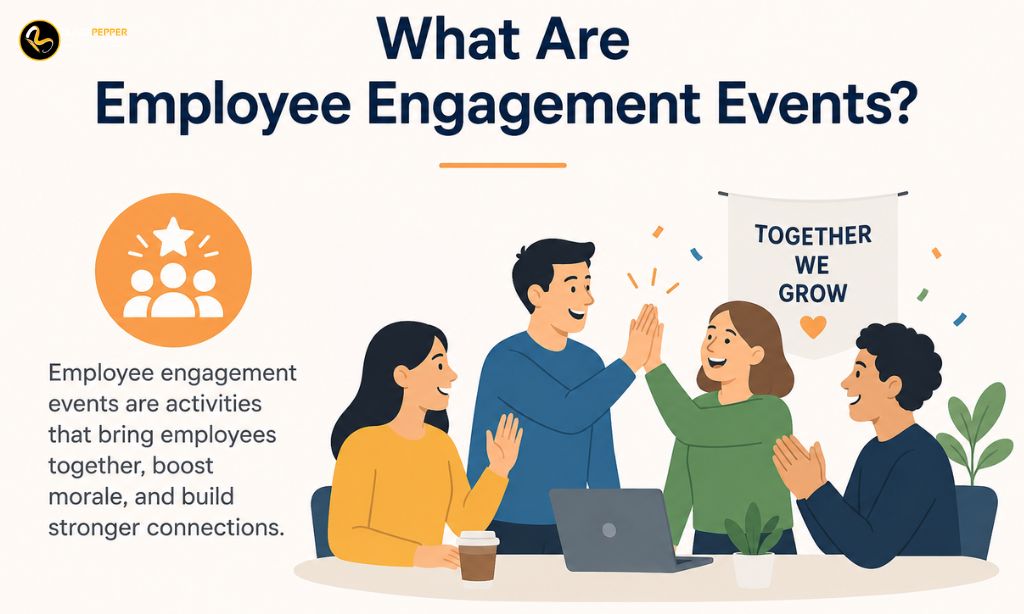
Employee engagement events are organised activities ranging from team outings and annual day celebrations to structured workshops and recognition ceremonies designed to strengthen employees’ emotional connection to their work, their team, and the organisation. Unlike a purely social gathering, a well-designed engagement event has a specific outcome in mind: better communication, stronger collaboration, or renewed motivation, achieved through a shared experience rather than a memo or a training slide deck.
Structured activities that require teams to collaborate under light pressure problem-solving challenges, team games, cross-functional projects surface communication habits that don’t show up in routine meetings, and give colleagues practice working together outside their usual reporting lines.
Recognition delivered publicly, in person, at a well-organised event carries more weight than the same recognition delivered over email. Employees who feel seen and valued consistently show higher day-to-day motivation than those who receive only routine performance feedback.
Teams that have shared a positive experience outside the office — a team outing, an off-site workshop, a celebration build the informal trust that makes day-to-day collaboration faster and less friction-heavy when deadlines are tight.
A well-timed engagement event breaks the monotony of a demanding work cycle, giving employees a genuine mental reset rather than a token gesture. Companies that schedule these consistently not just once a year report noticeably better team energy through sustained high-pressure periods.
Employees who feel a sense of belonging and recognition are measurably less likely to leave for a marginally better salary elsewhere. Engagement events are a direct, visible investment in that sense of belonging and are frequently cited in exit interview data as a factor employees will miss when they leave a company that did this well.
Annual days, award nights, and team celebrations become the shared reference points that define “what it’s like to work here” the stories employees tell new joiners and the memories that outlast any individual project.
Event Type | Best Suited For |
Annual Day & Award Nights | Company-wide recognition, celebrating yearly milestones and top performers |
Family Days | Building employee-family connection to the company, improving loyalty |
Team Outings | Strengthening bonds within specific teams or departments |
MICE (Meetings, Incentives, Conferences, Exhibitions) | Larger corporate gatherings combining business objectives with engagement |
Virtual & Hybrid Events | Distributed or remote-first teams that cannot gather in one location |
Workshops & Team-Building Activities | Skill-building combined with structured collaboration exercises |
The connection between engagement events and measurable performance runs through three specific mechanisms.
Company Size | Recommended Approach |
Startups (under 50 employees) | Informal team outings and small celebrations — high personal touch, low logistical complexity |
Mid-size companies (50–500) | Structured annual days, department-level team building, occasional larger off-sites |
Large enterprises (500+) | Multi-day MICE events, large-scale annual celebrations, and hybrid formats to include distributed offices |
Distributed / remote-first teams | Virtual and hybrid events designed specifically for remote participation, not an in-person event awkwardly livestreamed |
Common Mistake | Better Approach |
Treating engagement as a once-a-year checkbox | Schedule smaller, more frequent activities alongside the annual flagship event |
Planning without employee input | Survey preferences before finalising the format and activities |
Underestimating logistics for larger events | Bring in an experienced event partner once attendee count exceeds a few hundred |
No clear objective for the event | Define what success looks like — recognition, bonding, or stress relief — before planning starts |
Ignoring remote or distributed employees | Design a genuine hybrid experience, not an afterthought livestream |
Skipping post-event measurement | Run a short feedback survey within a week while the experience is still fresh |
Attendance numbers alone don’t tell you whether an event worked. A more complete measurement approach includes:
A corporate event management company brings three things an internal HR or admin team rarely has the bandwidth to deliver at scale: dedicated logistics management (venue, catering, transport, AV, production), creative event design that turns a generic team outing into a memorable experience, and vendor relationships that produce better pricing and reliability than a company arranging everything independently.
Corporate event planners also absorb the operational risk a missed vendor delivery, a last-minute venue issue, a weather disruption that would otherwise fall directly on an internal team that has a full-time job beyond event planning.
Black Pepper Events has been creating corporate experiences in Bangalore since 2008 — 17+ years of experience across 3,800+ events and 280+ clients, including companies such as Genpact, Flipkart, EY, TCS, Mahindra, and TVS Motors.
Employee engagement events work best as a consistent practice rather than a single annual gesture. Companies that treat engagement as an ongoing investment — through a mix of smaller team activities and larger flagship events — consistently see stronger communication, higher motivation, and better retention than those relying on one big event to carry the entire year’s culture-building effort.
Plan Your Next Employee Engagement Event Black Pepper Events has planned and executed employee engagement events for 280+ clients across India since 2008. From annual days to team outings and MICE events, our team handles the logistics so yours can focus on the people. 📞 Call / WhatsApp: +91 7338080555 |
How often should a company hold employee engagement events?
A mix of frequencies works best one flagship event annually (an annual day or award night) alongside smaller quarterly or even monthly team activities. Relying on a single yearly event to sustain engagement for the rest of the year is one of the most common planning mistakes.
What is the difference between team building events and employee engagement events?
Team building events are a subset of employee engagement events, specifically focused on improving collaboration and trust within a team through structured activities. Employee engagement events cover a broader range including recognition events, celebrations, and culture-building activities that don’t necessarily involve team-building exercises.
How do you measure ROI on employee engagement events?
Combine post-event feedback surveys, participation rate trends over time, follow-up pulse surveys on team morale, and longer-term retention data. No single metric captures the full picture the combination over multiple events gives the clearest signal.
Are virtual employee engagement events as effective as in-person events?
Well-designed virtual and hybrid events can be highly effective, particularly for distributed teams where in-person gathering isn’t practical. The key is designing specifically for the virtual format rather than simply livestreaming an in-person event as an afterthought.
How far in advance should a corporate engagement event be planned?
For smaller team outings, 4–6 weeks is generally sufficient. For larger annual days, award nights, or MICE events, 3–6 months of lead time allows for proper venue selection, vendor coordination, and creative planning without the cost premium and compromises that come with rushed logistics.
Written by Mohammad Asif Sr. SEO Executive, OneCity Technologies Mohammad Asif is a Senior SEO Executive at OneCity Technologies, Bangalore, with experience in SEO, content strategy, and digital marketing across corporate events, wedding venues, ecommerce, and automotive verticals. LinkedIn: https://www.linkedin.com/in/mohammad-asif-n-a-78435b234 |
Reviewed by L K Monu Borkala Chief Strategist, OneCity Technologies L K Monu Borkala is a digital marketing strategist with 20+ years of SEO experience and over 650 client campaigns across India and UAE. As a founding member of OneCity Technologies, Bangalore, he oversees content strategy, editorial compliance, and SEO frameworks across events, business services, and digital marketing verticals. LinkedIn: https://www.linkedin.com/in/monuborkala/ |